Showing posts with label anthropology. Show all posts

Wednesday, June 26, 2013

Scientific racism: a basic primer

The debate over racial science is popularly portrayed one of science vs. ideology. And it is.  Just not in the way most people think. 

Race has been in the news again quite a bit recently. Paula Deen, a celebrity chef, was refreshingly honest about her racism, and is now out of a job.  A couple of months ago one Jason Richwine also lost his job due to his racist beliefs.  Richwine is the more interesting case--he didn’t use racial slurs, but instead disguised his racism in the borrowed clothing of science.  To sum, the Washington Post discovered that Richwine, the coauthor of a prominent Heritage Foundation study on immigration, received his doctorate from Harvard on the basis of a dissertation that, even by Heritage Foundation standards, was jaw-droppingly racist.  The Heritage Foundation hastily showed Richwine the door. When I feel down, I like to imagine the awkward after-the-fact discussions at Harvard as to how they produced a PhD with a dissertation that was too nutty even for the Heritage Foundation. 

The public and media response to Richwine makes a striking contrast with the reception of the infamous The Bell Curve: Intelligence and Class Structure in American Life in 1994.  There was much more public controversy over Murrary and Herrnstein’s work than there was over Richwine’s similar work today.  Charles Murray has noticed this, but blamed it on the Heritage Foundations lack of “balls” compared to the American Enterprise Institute, where Murray happens to lair.  He’s wrong, of course.  He’s Charles Murray.  Dominant attitudes in US society have changed for one thing. Another thing that has changed is the availability of information (i.e., the Internet).  The scientific critiques of the work of people like Richwine are far more accessible to the public than they were in the 1990s. 

However there still seems to be strong popular suspicion that opposition to racial research is based on political beliefs rather than science. You can see this in, for example, Andrew Sullivan’s defence of (fellow wonk) Jason Richwine or skeptic Harriet Hall’s enthusiastic discussion of Berezow and Campbell’s Science Left Behind: Feel-Good Fallacies and the Rise of the Anti-Scientific Left--“Scientifically studying gender or racial differences is discouraged, if not completely taboo. It would be politically incorrect to find evidence suggesting that abilities are not fairly distributed.”

One  can point to a number of reasons that opposition to scientific racism is seen as ideological—the persistence of racial attitudes, the popularity of sociobiology and genetic determinism in the media, Libertarian political ideologies and the conequent need to explain long-term racial socio-economic inequality in a perfect economy, and so on.  But one simple, and I think easily-addressed, popular misconception is the idea that the study of human biological variation is the study of race—to deny the biological reality of race is to deny the biological reality of human variation.  Andrew Sullivan presents a good example of this kind of thinking. 
But the idea that natural selection and environmental adaptation stopped among human beings the minute we emerged in the planet 200,000 years ago – and that there are no genetic markers for geographical origin or destination – is bizarre. It would be deeply strange if Homo sapiens were the only species on earth that did not adapt to different climates, diseases, landscapes, and experiences over hundreds of millennia. We see such adaptation happening very quickly in the animal kingdom. Our skin color alone – clearly a genetic adaptation to climate – is, well, right in front of one’s nose.
 To sum, “race exists because…um…evolution does.”  

This is a misconception that scientific racists ( recently "race realists" but now Human Biodiversity (HBD) advocates) exploit.  The problem here is confusion between “race” and “population.”  Scientific racists, as well as a few well-meaning, but possibly tone-deaf, scientists, will use the two interchangeably.  Since “race” is an empty term, this is easy to do.  A researcher may write about “race” while defining it the same way as “population” (for whatever reason), and then be surprised when their work is lauded on Stormfront and shows up on the HBD Bibliography.  The simple fact is, if you want to use the word “race” you are not going to be able to separate it from its historical and social baggage.  You know what it means, so don’t use it.  

So what is “Race”?
Race is a vague folk concept, and like most folk concepts, is hard to scientifically pin down and operationalize . Basically it seems to be a bounded group of people with a similar "genetic makeup." Each race has a distinct genetic lineage with great historical depth (i.e. races are fixed and primordial units of human division). The human race is divided into a fixed number of races, usually five or six, (but there are taxonomies with many more). The standard taxonomy comes straight from the 18th-century classification--Caucasoid, Mongoloid, Negroid, etc.--but with more p.c. terminology (White, Asian, Black). Races usually have inherently different traits and abilities, usually labor-based—different races are suited for different tasks.

And what is "Population"?
A population is a local interbreeding group ("interbreeding" meaning that partners are found within the group more often than outside the group). Populations are definable entities. They are local, and the edges are (usually) clinal, fuzzy and indistinct as opposed to sharply bounded. On every continent you can have thousands and thousands of populations, moving around, dying out, forming new populations, and combining with other populations--doing all the things people do to screw up neat ideological categories.

Populations are also heriarchically organized.  That people reproduce with other people in the same vicinity means how you define a "population" depends on how you define the vicinity.  There is going to be population variation at a continental scale. But this is NOT the same thing as race.

So if races don't (biologically) exist, why are there individual genetic differences between "races"?
Human variation is complex, multidimensional, and historically and environmentally patterned. If you have a sufficiently complex set of patterned data, and you draw random lines through it, dividing it into X parts, the parts you create will differ, especially if you cherry pick the data carefully enough. To use an analogy, think of a mosaic. It is patterned, it is complex, and it tells a story. Now randomly draw lines through it, dividing it into four parts.  The colouring and constituents of those four parts are, mirabile dictu, going to be different. You now have five parts that are "scientifically proven” to be different. And you have lost the true richness of the story.

Race is not the same as population, and the existence of populations does not any way demonstrate the existence of races.

Racial Science as Pseudoscience
John Horgan half-jokingly asks "Should research into race and IQ be banned?".  Massimo  Pigliucci concludes a recent article by asking “When is enough enough?” It is time to start asking this question.

The simple fact is scientific racialism is a degenerate research program, now largely the province of zealots cocooned in right-wing think tanks. Its proponents have spent the last 200 years lurching from dataset to dataset, technology to technology, arguing that each new thing is going to be THE thing that finally proves that their object of study actually exists, but never pulling it off. And the human consequences of their research have been dire. I know of no legitimate research program that has gotten a pass like this.
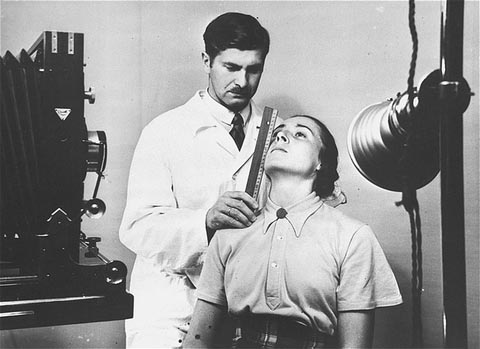
At the Kaiser Wilhelm Institute for Anthropology, Human Genetics, and Eugenics, a racial hygienist measures a woman's features in an attempt to determine her racial ancestry. Berlin, Germany, date uncertain.
— National Archives and Records Administration, College Park, Md. (from the US Holocaust Memorial Museum)


Scientific racism shouldn't be banned, but it is time for it to join research in cold fusion, homeopathy, and psi on the scholarly fringes.
--------------------------------------------------
References

Hall, Harriet
2013    Progressive Mythology.  Science-Based Medicine. May 21. http://www.sciencebasedmedicine.org/progressive-mythology/

Horgan, John
2013     Should Research on Race and IQ Be Banned? Cross-Check, Scientific American Blog Network. May 16. http://blogs.scientificamerican.com/cross-check/2013/05/16/should-research-on-race-and-iq-be-banned/.

Pigliucci, Massimo
2013     What Are We to Make of the Concept of Race?: Thoughts of a Philosopher–scientist. Studies in History and Philosophy of Science Part C: Studies in History and Philosophy of Biological and Biomedical Sciences. http://www.sciencedirect.com/science/article/pii/S1369848613000447.

Sullivan, Andrew
2013    Race and IQ. Again. The Dish, May 14.  http://dish.andrewsullivan.com/2013/05/14/is-christopher-jencks-a-racist/
 

Sunday, August 26, 2012

Cultural Relativism and Skepticism

Will at Skepchick has a nice piece on Franz Boas. I liked what he had to say about cultural relativism, especially given that it is a skeptical blog. 
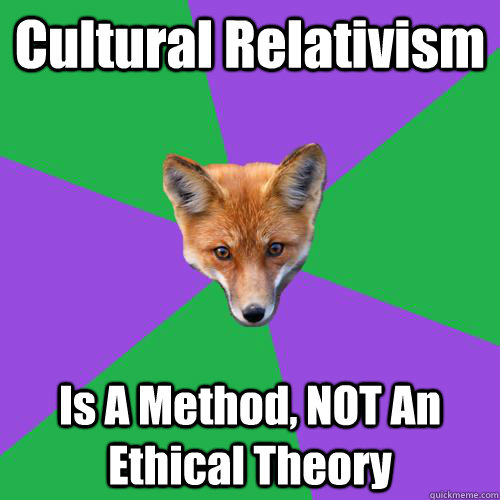
I know "relativism" is often a dirty word among many skeptics, but I find that this is generally based on a conflation of any kind of "relativism" with "moral relativism." Cultural relativism as introduced by Boas is simply a method of anthropological inquiry that says that the best way to understand why a culture is the way it is (or why people within a society do things in a certain way) is to gain an emic (or insider's) understanding. Cultural relativism as a method is the rejection of ethnocentrism when trying to learn about other societies. Cultural relativism should not be conflated with moral relativism, which is the idea that there are no objective or absolute moral or ethical standards such that morals should never be judged as objectively good or bad. Cultural relativism is a method that seeks to suspend value judgments in order to understand a particular phenomenon. Anthropologists also draw on an eitc (outsider's) understanding, not during the process of data collection but during data analysis and writing the ethnography.

Moral relativism has very little to do with Boasian cultural relativism. Boas himself held very strong views about the morality of racism and human rights. For Boas (and for American anthropologists today), an attempt to approach other cultural systems with dispassionate objectivity (i.e., cultural relativism) did not entail moral disengagement from the world (i.e., moral relativism). In this way, Boasian cultural relativism is an attempt to apply scientific objectivity to the study of human culture.
The skeptics and atheist communities do have a "thing" about cultural relativism. I'd add add two more reasons to Will's observation. 

1) These are movements established around being right about the wrongness of certain beliefs--pseudo-science, alternative medicine, god.  Confronting these beliefs is important.  That's not a point I need to stress.  But it isn't something I consider "fun", at least after a certain point. There is pleasure in demolishing someone with a well rehearsed set of arguments, but I have to admit it is a bit of a douchey pleasure. But there are other engagements with difference, where it is not clear who is right and wrong.  These engagements are rewarding, but in another way.

Anthropology is about this second type of engagement, about understanding people who have different beliefs, rather than proving them wrong.  On a practical level, as a basis for action, understanding why people have obviously wrong beliefs is more useful than simply proving those beliefs wrong over and over.  Right there, that makes anthropology an object of suspicion for many skeptics. For these skeptics, difference entails someone being right and someone being wrong.  I wonder if this attitude might be part of the current skeptical/atheist meltdown over the treatment of people who are different (i.e., not white cisgendered males). 

2) Another problem is the charismatic figures of the skeptic/atheist movement, such as Christopher Hitchens and Richard Dawkins, are not exactly examplars of cultural understanding.  Part of their appeal is the decisiveness and clarity that comes with moral certainty. 

Finally, as Will says, cultural relativism tends to be a huge straw man, being conflated with an undefined  series of "fings wot I don't like"--things like postmodernism, political correctness, and multiculturalism.  This seems to be true even with relatively thoughtful skeptics. 

Most skeptics' understanding of cultural relativism probably comes from these two paragraphs in Dawkin's 1995 book River out of Eden.
There is a fashionable salon philosophy called cultural relativism which holds, in its extreme form, that science has no more claim to truth than tribal myth: science is just the mythology favored by our modern Western tribe. I once was provoked by an anthropologist colleague into putting the point starkly, as follows: Suppose there is a tribe, I said, who believe that the moon is an old calabash tossed into the sky, hanging only just out of reach above the treetops. Do you really claim that our scientific truth-that the moon is about a quarter of a million miles away and a quarter the diameter of the Earth-is no more true than the tribe's calabash? "Yes," the anthropologist said. "We are just brought up in a culture that sees the world in a scientific way. They are brought up to see the world in another way. Neither way is more true than the other."
Show me a cultural relativist at thirty thousand feet and I'll show you a hypocrite. Airplanes built according to scientific principles work. They stay aloft, and they get you to a chosen destination. Airplanes built to tribal or mythological specifications, such as the dummy planes of the cargo cults in jungle clearings or the beeswaxed wings of Icarus, don't.* If you are flying to an international congress of anthropologists or literary critics, the reason you will probably get there-the reason you don't plummet into a ploughed field-is that a lot of Western scientifically trained engineers have got their suns right. Western science, acting on good evidence that the moon orbits the Earth a quarter of a million miles away, using Western-designed computers and rockets, has succeeded in placing people on its surface. Tribal science, believing that the moon is just above the treetops, will never touch it outside of dreams.
[Damn, if nothing else Dawkins is a formidable quotable sound-bite producing machine. Let me tell you, having the basic underpinning of anthropology and archaeology (both fieldwork-oriented disciplines) dismissed as "fashionable salon philosophy," and by Richard Dawkins of all people, is a bracing experience.] 

I realise Dawkin's isn't really making a scholarly argument here, merely pandering to his base, but it still an awesomely ignorant argument. He is making the standard mistake of conflating cultural relativism with epistemological relativism and what is no doubt postmodernism. He does try to put a fig leaf over his nonsense by the use of "in its extreme form" and a rather dubious anecdote, but it is nonetheless an outrageous straw man.

At its core cultural relativism is, as Will notes, an attempt to apply scientific objectivity to the study of human culture. There is some element of at least the popular understanding of moral relativism involved, in that a suspension of moral judgment is required (the content of morality being cultural). Think about it.  In what field does one approach one's object with prejudice (i.e pre-judgement) as a valid tool?  Does a biologist judge some animals as "good" and some as "bad" based on ideology?  Would you take your car to a mechanic who reached decisions based on whether he thought the engine was good or evil?  Probably not.

Anthropology is the study of human variation--cultural, linguistic and physical--across and through time.  Humans are the anthropological object of study. Cultural relativism is the appropriate scientific stance for the study of human variation.  If you disagree with this, then what is the appropriate stance? As a basis for action in the world, explanations like "their beliefs suck" and "they are evil and hate our freedoms" have not worked out so well.  If a group has beliefs we find reprehensible, it is still worthwhile, and practically more useful, to find out why they have those beliefs. 

I will be honest, the fact of the object of anthropology is people complicates things no end. It would not surprise me if Dawkin's anecdote is true.  Anthropologists' "objects" are subjects, who study us back, and we are implicated with them through multiple sets of relations, relations that do not play a role in the considerations of, say, physicists or biologists.  Anthropologists have responsibilities and obligations that other fields do not.  There is debate within the field as to what cultural relativism means beyond being an objective perspective. But if you are going to take issue with cultural relativism as something other than a neutral stance for the study of human difference, you then need to be explicit about who you are talking about and what their arguments are.  Cutesy anecdotes about anonymous anthropologists are not useful.
-----------------------------------------------------------
References cited

Dawkins, Richard
1995  A River out of Eden: A Darwinian View of Life.  BasicBooks, New York, NY.