Showing posts with label scientism. Show all posts

Sunday, October 28, 2012

Steven Pinker and archaeology

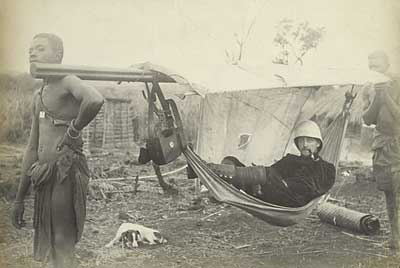
Traveling in a hammock, Belgian Congo
National Museum of African Art
Smithsonian Institution
1977-0001-171
This is my second post on Steven Pinker’s Better Angels of Our Nature (the first is here). This book is such a steaming pile, I need to vent but really don't want to spend time on it.  So I am going to end this particular foray into the colonial mindset and finish up on Chapter 2, which is the main archaeological and anthropological section. In this chapter Pinker argues that there has been a significant decrease in violence as a result of the development of the state. He presents his main evidence for this in a chart—Figure 2-2 in the book, but the same data is presented in two separate charts in an Edge talk he gave. The archaeological charts is below, but it is probably best to look at the chart in the book.


In my earlier post on the topic, I went over some of the more general conceptual issues Pinker faces in comparing non-state/state violence.  In this post I am concentrating on the actual quality of his evidence.  I am just going to talk about the archaeological data, otherwise things are going to get totally unmanageable, and I will never get to stop writing about the book. 

Pinker's evidence that the development of the state led to a significant decrease in violence is gleaned from a grab-bag of archaeological and ethnographic studies--studies that focus on human violence. He uses different datasets at each stage of his chart, none of which I think he really understands. His data for prehistory is the percentage of skeletons showing signs of fatal violence within each site, or group of sites.  The data for modern hunter-gatherer and horticulturalist societies is for the most part ethnographic data gathered through oral histories and reports.  The data for states is probably the most reliable (other than the Ancient Mexico figure). A big problem is here is that, although Pinker intends the chart to compare violent deaths in state and non-state societies, the only actual “state” included in the chart is the US (in 2005). The data are all harvested from secondary sources, some of which are highly questionable, and none of which were trying to answer Pinker’s basic question (actually it is an assumption, but let’s be charitable) —”is there a decline in violence from non-state to state societies?”

Even to those without an archaeological, anthropological, or historical background Pinker’s Figure 2-2 must appear dubious.  The big issue is figuring out exactly what is being compared here; what are the categories on the X axis and what is being measured on the Y axis?  The entities being compared are very different.  We start off with prehistory being represented by cemetery sites, or clusters of cemetery sites, leap to 19th/20th century hunter-gatherer/horticulturalist societies, then we come to “states.”  Notice that of the eight categories here, only one, the “U.S.  2005” is actually a state.  The rest are geographical regions (Ancient Mexico, Europe, and the World).  Pinker has made no effort to maintain an even roughly consistent scale of comparison.  This is important since the bigger the sample, the more variation will wash out.

The time frames represented by each category also fluctuate wildly, from days at one end up to centuries at the other.  What sense does it make to compare a mass-burial from a one-day massacre (the Crow Creek Site) to the planet Earth in the entire 20th century?  What possible conclusion can one draw from such a comparison?  

In the following table, I’ve listed the archaeological sites he uses in his argument.  I reviewed his original sources and, where I could figure it out, included the number of individuals in each cemetery (data that he really should have included).  There are some issues with his data that I need to address before proceeding.  A relatively minor, but still  significant, problem with this figure is how poorly it is cited.  One has to go through a pile of references hoping to find a match.  Fortunately Pinker used only three sources for his archaeological and ethnographic data—Lawrence Keeley’s War Before Civilization: The Myth of the Peaceful Savage (1996), an article in Science by  Samuel Bowles ("Did Warfare Among Ancestral Hunter-Gatherers Affect the Evolution of Human Social Behaviors?"), and Azar Gat’s 20008 War in Human Civilization.  Even so, I couldn't find all the sites in these books, so the chart may not be fully cited.


Site
Dates
# burials
deaths by warfare
Nubia, nr. Site 117
12000-10000 BCE
39
3
Djebel Sahaba Nubia (Site 117)
2000-10000 BCE
41
46
Calumnata, Algeria
6300BCE-5300 BCE
53
4
Gobero, Niger
14000-6200 BCE
35
0
Volos’ke Ukraine
7500 BCE
18
22
Vasiliv’ka Ukraine
9000 BCE
32
1
Boggebakken Denmark
4300-3800 CE
17
12
Vedbaek Denmark
4100 CE
17
14
Skateholm I, Sweden
4100 BCE
30
7
Brittany
6000 BCE
?
8
Ile Teviec France
4600 BCE
16
12
British Columbia 30 sites
3500BCE-1674 CE
745
23
Central California
1500BCE-1500 CE
?
 5
Central California
1400BCE-235 CE
?
5
Central California (2 sites)
240CE-1770 CE (?)
248
4
S. California 28 sites
1400 BCE-235 CE
840
6
Kentucky (2750 BCE)
2750 BCE
?
6
Crow Creek, South Dakota
1325 CE
486
60
Illinois
1300 CE.
264
16
Northeast Plains
1435 CE
?
15
Sara Nahar Rai, India
2140-850 BCE
10
30


I've grouped my carping about the archaeological evidence into three main categories: (1) Pinker's understanding of the data (2) Pinker's sample size, and (3) the manner in which Pinker selected his sample.

1) Poorly understood data

Djebel Sahaba (Site 117) and the “nr. Site 117” Site.  These sites should be grouped.  they probably belong to the same community.  Pinker uses grouped data in other cases, so he probably should here.  Or Djebel Sahaba should be dropped as representing something exceptional, either the remains of a battle or massacre, or the community buried people who died by violence separately.  Speaking the sites that might represent exceptional events…

Crow Creek, South Dakota.  This is a notorious site.  It is a mass grave, the remains of a massacre.  Using this site as just automatically representative of prehistoric mortality is senseless, especially when your sample is already small and biased.  There are no mass graves from Europe in the 20th century?  What would Pinker’s state-level death rates look like if he used cemetery data (as he should have)?

Vedbaek, Denmark, and Boggebakken, Denmark.  This is bad.  Unless there are two Mesolithic sites with 17 burials in Vedbaek, these are the same site.  Keeley calls it Vedbaek; Bowles calls it Boggebakken. The site is sometimes called Vedbaek-Boggebakken (e.g., Jochim 2011:127).  If these are the same site  (as they certainly seem to be), this is probably the most egregious error in Pinker’s data.  The rest of the errors can be attributed to lack of understanding of the evidence and appropriate methods.  But, this, THIS, is sheer laziness. He made no effort to clean his data.

As a side note, this mistake shows the importance of not just dumping other people’s numbers in to a hopper—“Vedbaek” (from Keeley) is 14% mortality, while “Boggebakken” (from Bowles) is 12%-- different numbers for the same site. This is probably because Bowles was only counting adults.  If you are going to use numbers from different studies, make sure the numbers mean the same thing. 

2) Sample sizes

Another issue to be aware of, especially if one quantifying and comparing data, is sample sizes.  Pinker doesn’t include how many individuals are represented by each cemetery in his sample, so I trawled through the sources to recover that information (information that should have damn well been in the book).  The problem here is the smaller the number of individuals in the cemetery, the greater the statistical impact of an individual showing evidence of violent death.  If there are only ten individuals in a cemetery, the percentage will jump by 10% increments.  Those are big jumps.   Note Sara Nahar Rai has a total count of only 10.  Ile Teviec only 16.  Boggebakken has a count of 17 (as does Vedbaek, for obvious reasons :) ).  Volos’ke has 18.  We need to consider whether these are adequate samples, especially when the comparative cases are continents and the entire world.  For Pinker’s analysis, which boils down to visual comparisons of percentages of uncorrected data (with the prehistoric data being summarized as a mean without error bars), I would be hesitant to use anything less than 50, simply because the statistical impact of single deaths is going to be exaggerated. 

3) Sample selection

This is probably the single largest problem with Pinker’s evidence.  In any kind of quantitative study, a first consideration is sample selection.  Is the sample biased?  Is it representative or has the author cherry-picked only the data that supports their position?  What is immediately obvious in reading Pinker’s discussion of his data is the absence of any kind of methodological discussion, and how few sites are presented as evidence.  Those are two big, bright red flags.  Pinker presents his methods for sample selections as being simply the sites “that he knew of”.  The criteria of selection is simply that he knew of the sites, more precisely he knew of these sites because they were given in tables in Keeley (1996) and Bowles (2009)—two sources dealing with violence in prehistory. Keeley was interested in demonstrating the existence of violence in prehistory, not its extent.  For this goal it was adequate to simply find sites where violence existed.  It is basically a collection of anecdotes.  We cannot use his collection of sites to infer the extent of violence because he only picked sites that showed evidence of violence.  The sample is fine for Keeley’s argument, but not for Pinker’s.  Bowles, beyond noting that he “studied all available archaeological and ethnographic sources that present (or are cited as presenting) relevant data”, does not discuss his sample selection at all, which is surprising for a Science article.  The emphasis of his article is on intergroup violence, and his sample is certainly skewed towards cemeteries that show signs of violence.  

If these are the only sites that Pinker “knew of”, he did not do enough research.  What he needed here was some kind of sampling design.  In relying solely on Keeley and Bowles, (as well as Gat for the ethnographic data), Pinker guaranteed, whether he realised it or not, that he would have a dataset consisting of practically nothing but cemeteries that show evidence of violence.  I don’t know how many prehistoric cemeteries have been excavated, and I don’t how many show no evidence of violence (hundreds at least, maybe thousands). Pinker needed a sampling program that would take  into account a population of all known cemeteries, not just those that showed evidence of violent death.  Given Pinker’s selection of the data, it is a given that non-state societies will be more violent, but this is the result of cherry-picked evidence, not necessarily reality.

I think, since WWII, we have seen an overall decline in death by violence.  Does this 60 years translate to “states are less violent than non-state societies.”  Of course not.  I am not sure it is even a meaningful question due to the different ways in which states and non-state societies deliver violence, and due to historical variation.  It may be possible to answer this question, or at least weigh in on it, but Pinker hasn’t done so.  He is not even wrong. You cannot pull something like this off without a great deal of historical understanding. If Pinker has such an understanding, it is not evident in Better Angels.  Instead he approaches the historical disciplines as factoid mines, carefully picking out the numbers he wants, and tossing them into an ideological hopper.  Better Angels fails as science and as history at a very basic level.   

----------------------------------------------------------
References cited

Bowles, Samuel
2009     Did Warfare Among Ancestral Hunter-Gatherers Affect the Evolution of Human Social Behaviors? Science 324(5932):1293–1298.

Gat, Azar
2008     War in Human Civilization. Oxford, UK, Oxford University Press.

Jochim, Michael
2011     The Mesolithic. In European Prehistory: A Survey, Sarunas Milisauskas, editor, pp. 125–152. New York, Springer.

Pinker, Steven
2011a     A History Of Violence Edge Master Class 2011. Edge. http://www.edge.org/conversation/mc2011-history-violence-pinker.

2011b     The Better Angels of Our Nature: Why Violence Has Declined. First edition  New York, NY, Viking

Wednesday, September 19, 2012

And again...is archaeology science?

And we have a resounding “NO!” from Willie Mc Loud of Life in the Universe. In fact archaeology’s not even history either. Harsh.

This is old ground, and I don’t have the burning interest in the topic that I used to, but  I was interested in what Loud had to say because he isn’t an archaeologist, but a physicist, one with, apparently, an interest in archaeology. Now I do think if you are going to criticise a discipline, it behooves you to get up to speed on the basics of that discipline, at least enough that the criticisms make sense. Loud stumbles in this regard. For example, his criticisms of archaeological dating made no sense to me until I realised he was unaware of the difference between dendrochronology and radiocarbon dating. Mistakes like that are a red flag, and make it hard to exercise the principle of charity.  But we must.  

Loud has some definitional problems.  His take on the goals of archaeology, and history for that matter, is pretty limited. His interest is Mesopotamian archaeology, and I suspect he, as with many buffs, is interested in archaeology insofar as it can fill in gaps in a rather conventional history. In his examples he judges archaeology on whether it can identify the reign dates of Naram-Sin, the occurrence of a historically recorded “great rebellion” against the aforementioned Naram-Sin, the existence of the Akkadian Empire, or the presence of Assyrian colonies in Anatolia.  This is “pots=peoples” archaeology failing at “big men, big battles” history.  Archaeology does not excel at this kind of history.  In fact history does not excel at this kind of history.  

His other definitional problem is what he means by “science”.  He’s a little slippery here, conflating “empirical science” (which is in reality all science) with experimental science.  An experimental science is one whose findings come from controlled repeatable experiments.  By this definition, psychology is a science, but astronomy, geology, evolutionary biology, and, yes, archaeology are not. Obviously not all sciences are experimental sciences—there is an important distinction to be made here between experimental and historical science, in which researchers use  pre-existing evidentiary traces to discriminate among hypotheses (e.g. Cleland 2002). If archaeology is a science, it is a historical science, not an experimental one (setting aside the subfield of experimental archaeology).  
       
Loud also criticises archaeology for problems that are general in science.  He notes, for example, that “archaeological data is provisional in the sense that there is always the possibility that new data will be found that could (even dramatically) alter the picture.” I assume he means archaeological interpretations or theories are provisional, rather than “data”.  Regardless, it seems an unfair observation, since provisionality and a willingness to revise theories in the face of new data are hallmarks of science. 

He is careful to note that scientists that scientists approximate reality rather than discover it, writing that “although reality exists, we do not know - and would probably never know - what it truly is like.  There is absolutely no way to establish whether any model describes reality as it really is - the best we can hope for is that models provide reliable results when tested against reality. ”  Of course this phrasing raises the question of how one “tests” models against an unknowable reality. What we actually do is test models against human interpretations of the effects (”evidence” or “data”) of that unknowable reality.  This is an important distinction, since he then goes on to state that archaeologists cannot test models since the reality they are approximating no longer exists. There are a lot of criticisms I can make of Loud’s idea that the particular reality under investigation needs to be coterminous with the researcher to be available for testing. But the simplest one is that it doesn’t, not in the historical sciences. For examples, nobody deals with long-gone realities like astronomers do.  The effects of the bygone reality are still present, and that is what we test against.  I also wonder at the practical difference between testing against the effects of an unknowable extant reality, and testing against the effects of an unknowable extinct reality. The practical difference between the two is non-existent.  

The question of whether archaeology as a whole is science is not one I worry much about anymore.  A lot depends the questions the archaeologist is asking—some variation no doubt of Christopher Hawkes’ “Ladder of Inference”.  When humans first migrated into the Americas is a scientific question.  How a group of people uses material culture to assert (or deny) group identity is less so, but nonetheless still worth exploring.  We can’t just look where the light is strongest.  Also archaeology, like history, is a form of social memory and thus embroiled in contemporary politics in a way that physics and geology are not.  

For the most part I agree with Loud that the kind of archaeology and questions he is interested in are not science. I just disagree with his reasons, and that his experience of archaeology is sufficient to take on the whole field.  Maybe a more limited title?

----------------------------------------------------------
References cited

Cleland, Carol E.
2002    Methodological and Epistemic Differences Between Historical Science and Experimental Science. Philosophy of Science 69(3):447–451.

Loud, Willie Mc 
2012    A critique of archaeology as a scienceLife in the Universe.  Posted 19 August 2012. 

Sunday, August 26, 2012

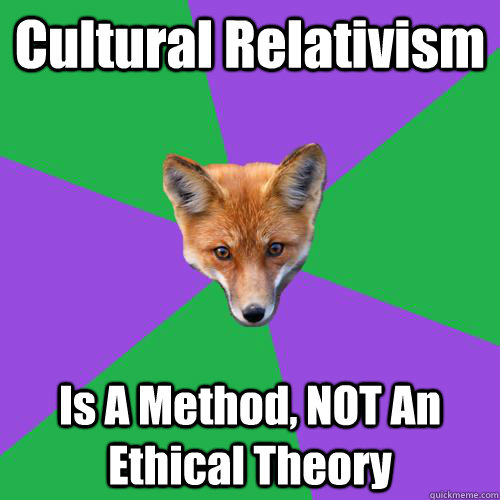
Cultural Relativism and Skepticism

Will at Skepchick has a nice piece on Franz Boas. I liked what he had to say about cultural relativism, especially given that it is a skeptical blog. 
I know "relativism" is often a dirty word among many skeptics, but I find that this is generally based on a conflation of any kind of "relativism" with "moral relativism." Cultural relativism as introduced by Boas is simply a method of anthropological inquiry that says that the best way to understand why a culture is the way it is (or why people within a society do things in a certain way) is to gain an emic (or insider's) understanding. Cultural relativism as a method is the rejection of ethnocentrism when trying to learn about other societies. Cultural relativism should not be conflated with moral relativism, which is the idea that there are no objective or absolute moral or ethical standards such that morals should never be judged as objectively good or bad. Cultural relativism is a method that seeks to suspend value judgments in order to understand a particular phenomenon. Anthropologists also draw on an eitc (outsider's) understanding, not during the process of data collection but during data analysis and writing the ethnography.

Moral relativism has very little to do with Boasian cultural relativism. Boas himself held very strong views about the morality of racism and human rights. For Boas (and for American anthropologists today), an attempt to approach other cultural systems with dispassionate objectivity (i.e., cultural relativism) did not entail moral disengagement from the world (i.e., moral relativism). In this way, Boasian cultural relativism is an attempt to apply scientific objectivity to the study of human culture.
The skeptics and atheist communities do have a "thing" about cultural relativism. I'd add add two more reasons to Will's observation. 

1) These are movements established around being right about the wrongness of certain beliefs--pseudo-science, alternative medicine, god.  Confronting these beliefs is important.  That's not a point I need to stress.  But it isn't something I consider "fun", at least after a certain point. There is pleasure in demolishing someone with a well rehearsed set of arguments, but I have to admit it is a bit of a douchey pleasure. But there are other engagements with difference, where it is not clear who is right and wrong.  These engagements are rewarding, but in another way.

Anthropology is about this second type of engagement, about understanding people who have different beliefs, rather than proving them wrong.  On a practical level, as a basis for action, understanding why people have obviously wrong beliefs is more useful than simply proving those beliefs wrong over and over.  Right there, that makes anthropology an object of suspicion for many skeptics. For these skeptics, difference entails someone being right and someone being wrong.  I wonder if this attitude might be part of the current skeptical/atheist meltdown over the treatment of people who are different (i.e., not white cisgendered males). 

2) Another problem is the charismatic figures of the skeptic/atheist movement, such as Christopher Hitchens and Richard Dawkins, are not exactly examplars of cultural understanding.  Part of their appeal is the decisiveness and clarity that comes with moral certainty. 

Finally, as Will says, cultural relativism tends to be a huge straw man, being conflated with an undefined  series of "fings wot I don't like"--things like postmodernism, political correctness, and multiculturalism.  This seems to be true even with relatively thoughtful skeptics. 

Most skeptics' understanding of cultural relativism probably comes from these two paragraphs in Dawkin's 1995 book River out of Eden.
There is a fashionable salon philosophy called cultural relativism which holds, in its extreme form, that science has no more claim to truth than tribal myth: science is just the mythology favored by our modern Western tribe. I once was provoked by an anthropologist colleague into putting the point starkly, as follows: Suppose there is a tribe, I said, who believe that the moon is an old calabash tossed into the sky, hanging only just out of reach above the treetops. Do you really claim that our scientific truth-that the moon is about a quarter of a million miles away and a quarter the diameter of the Earth-is no more true than the tribe's calabash? "Yes," the anthropologist said. "We are just brought up in a culture that sees the world in a scientific way. They are brought up to see the world in another way. Neither way is more true than the other."
Show me a cultural relativist at thirty thousand feet and I'll show you a hypocrite. Airplanes built according to scientific principles work. They stay aloft, and they get you to a chosen destination. Airplanes built to tribal or mythological specifications, such as the dummy planes of the cargo cults in jungle clearings or the beeswaxed wings of Icarus, don't.* If you are flying to an international congress of anthropologists or literary critics, the reason you will probably get there-the reason you don't plummet into a ploughed field-is that a lot of Western scientifically trained engineers have got their suns right. Western science, acting on good evidence that the moon orbits the Earth a quarter of a million miles away, using Western-designed computers and rockets, has succeeded in placing people on its surface. Tribal science, believing that the moon is just above the treetops, will never touch it outside of dreams.
[Damn, if nothing else Dawkins is a formidable quotable sound-bite producing machine. Let me tell you, having the basic underpinning of anthropology and archaeology (both fieldwork-oriented disciplines) dismissed as "fashionable salon philosophy," and by Richard Dawkins of all people, is a bracing experience.] 

I realise Dawkin's isn't really making a scholarly argument here, merely pandering to his base, but it still an awesomely ignorant argument. He is making the standard mistake of conflating cultural relativism with epistemological relativism and what is no doubt postmodernism. He does try to put a fig leaf over his nonsense by the use of "in its extreme form" and a rather dubious anecdote, but it is nonetheless an outrageous straw man.

At its core cultural relativism is, as Will notes, an attempt to apply scientific objectivity to the study of human culture. There is some element of at least the popular understanding of moral relativism involved, in that a suspension of moral judgment is required (the content of morality being cultural). Think about it.  In what field does one approach one's object with prejudice (i.e pre-judgement) as a valid tool?  Does a biologist judge some animals as "good" and some as "bad" based on ideology?  Would you take your car to a mechanic who reached decisions based on whether he thought the engine was good or evil?  Probably not.

Anthropology is the study of human variation--cultural, linguistic and physical--across and through time.  Humans are the anthropological object of study. Cultural relativism is the appropriate scientific stance for the study of human variation.  If you disagree with this, then what is the appropriate stance? As a basis for action in the world, explanations like "their beliefs suck" and "they are evil and hate our freedoms" have not worked out so well.  If a group has beliefs we find reprehensible, it is still worthwhile, and practically more useful, to find out why they have those beliefs. 

I will be honest, the fact of the object of anthropology is people complicates things no end. It would not surprise me if Dawkin's anecdote is true.  Anthropologists' "objects" are subjects, who study us back, and we are implicated with them through multiple sets of relations, relations that do not play a role in the considerations of, say, physicists or biologists.  Anthropologists have responsibilities and obligations that other fields do not.  There is debate within the field as to what cultural relativism means beyond being an objective perspective. But if you are going to take issue with cultural relativism as something other than a neutral stance for the study of human difference, you then need to be explicit about who you are talking about and what their arguments are.  Cutesy anecdotes about anonymous anthropologists are not useful.
-----------------------------------------------------------
References cited

Dawkins, Richard
1995  A River out of Eden: A Darwinian View of Life.  BasicBooks, New York, NY.


Saturday, August 18, 2012

Scienciness and History: Cliodynamics

There seems to be an uptick in historical studies by scientists (henceforth Scientists-Doing-History or SDH). I guess everyone wants to be the next Jared Diamond.  As a recent example, a couple of physicists (Mac Carron and Kenna 2012) have published a study comparing networks in myths (Beowulf, the Iliad, and the Táin Bó Cuailnge) and fiction (Les Misérables, Richard III, The Fellowship of the  Ring, and Harry Potter). It got worked over in detail by Richard Carrier at Freethought Blogs (Bad Science Proves Demigods Exist!) and more generally by Maria Konnikova at Scientific American (Humanities aren’t a science. Stop treating them like one). I feel a little bad for the authors.  It was a small study in a physics journal and could have stayed buried there, but it may have become a lightning rod for irate humanities researchers. 

There have also been some higher profile efforts to bring scienciness to bear on world history. Jared Diamond and Guns, Germs and Steel (1997) is obviously the success story here. Now Steven Pinker (2011) has published a large trade press book on violence and human nature, The Better Angels of our Nature, my encounter with which has left me with a nervous twitch. I’m trying to write up something on that one, but it is hard to know where to begin. Another aspirant is Peter Turchin, another evolutionary biologist who has decided to apply himself to history, even coining a neologism, “cliodynamics.”  I’m a little disappointed he didn’t call it clionomics  (although we do, thank god, have “culturomics,” which, if nothing else, gave us the fun Google N-gram Viewer).

Turchin has been plugging cliodynamics for a while, but he just published a study in the Journal of Peace Research on “The dynamics of political instability in the United States, 1780-2010” (Turchin 2012). Nature had a piece on it by Laura Spinney, and it also broke through into the mass media  with a piece at MSNBC, probably because Turchin excitingly predicts a violent upheaval in 2020.  Maria Konnikova at Literally psyched criticised it also in the aforementioned post, and Rebekah Higgitt at the Guardian and Paul Lay at History Today have also weighed in.  Rebekah Higgitt had the best subtitle, one that perfectly sums up the exasperation of many historians at the Scientists-Doing History” genre--”At least one historical prediction holds true: the regular appearance of claims to have the key to 'scientific history'.”

To be clear, when I refer to history and historians here, I am referring to the disciplines that study the human past, whether they do so from an anthropological or historical perspective, so I am scandalously folding archaeology into history.  I couldn’t keep writing “historical disciplines” and I wasn’t going to write “historical disciplinarians.”

SCIENCE, HISTORY, AND DATA
I am not quite sure what cliodynamics is.  At its most general it seems to be synomous with quantitative approaches to “big history” and at its most specific it is Turchin’s particular approach.  Making the assumption that cliodynamics is more than a rebranding exercise, I use the term to refer to Turchin’s particular approach— a combo of using quantitiative methods to empirically identify historical cycles, and explaining those cycles in terms of “structural-demographic theory.”

The big contribution of SDH is the idea one can solve history simply by slapping down the correct method on the nearest datasets. I don't think this works. You can’t just shovel numbers into your statistical/ideological hobbyhorse and hope for something worthwhile to come out the other end.  You need to understand the data you are using. Minimally you need to understand how the numbers were created. If any data is “socially constructed” it is historical data. I imagine understanding one’s data is good practice in science as well as history. It is this point that Richard Carrier emphasized in his critique of Mac Carron and Kenna. This attitude apparently led to at least one howler in Turchin’s book Historical Dynamics: Why States Rise and Fall (Tainter 2004). He used two peaks in archaeological settlement data from Roman Gaul as population oscillations, not realising that the first corresponded to Romanization and the establishment of colonia, and the second to changes in taxation under Diocletian.

These contrasting explanations (a spike in archaeological site frequencies as a result of secular cycles vs. as a result of conquest and settlement) bring us to the “D” word—determinism. If you are a SDH, you’ve got a fever, and the only prescription is deterministic monocausal explanations. Why? The argument seems to be because superficially similar phenomena must have identical explanations.  Maybe only humanities majors worry about things like affirming the consequent, equifinality, and contingency. Logical problems aside, the key divide seems to be one of determinism vs. contingency. In Guns, Germs, and Steel Jared Diamond defined contingency away by arguing that the “proximate” contingent causes were themselves caused by “ultimate” deterministic causes (since he is a biogeographer, his “ultimate causes are geographical ones). The contingent causes exist, but they aren’t important. 

I am not sure if Turchin ever explictly addressed critiques of his work and thus how he deals with historically-specific alternative explanations for his historical cycles, but I would suspect a similar tactic. For example, in the Peace Studies article he sees immigration in to the US as the fundamental cause of political instability during that period (by driving up labor oversupply). Personally, I think you need to not know an awful lot about US history and the dynamics of migration to make an argument like that. But for Turchin, the concrete arguments (boom and bust economic cycles, the growth of industrial capitalism, etc.) are probably just "proximate" causes.  The ultimate cause?  Population growth through immigration.  As an aside, given the current nativist climate, this is probably an argument that will, unfortunately, garner a great deal of attention—science proves the need for immigration crackdowns. 

Turchin’s current article is better than many of this genre in one regard, possibly because he may taking some of the criticism of his previous work seriously, if not addressing it explicitly. Here he deserves credit for using his cliodynamical hammer on a single case, using a relatively consistent data set, and one that he gathered himself. He does seem to be a more aware that there are methodological issues in gathering and classifying data as well as just analysing it.  This stands in contrast to Steven Pinker’s credulous reliance on dimly understood secondary sources in Better Angels. The problems may still be there with Turchin’s work, but but by focusing on a single case with a good dataset he at least allows one to get a handle on the problems, rather than having to ramble backwards and forwards over multiple areas, periods, and specialties.  When the evidence is cherry-picked from the entirety of world history, it is a little harder to engage in substantive critique. At the very worst, Turchin has reduced the problems to a manageable scale.

By taking this more focused approach Turchin may be able to kick his cliodynamical research program out of first gear, which is where it seems to be stuck. I am not sure though. Cliodynamics still seems to have a tight citation circle, which is not a sign of a particularly healthy research program. And by "tight", I mean really tight. The degree to which Turchin cites himself in this article is positively embarrassing, especially given how well-worked his historical ground is.  It does indicate a disturbing insularity and lack of engagement with the relevant historical literature.

Another danger signal is that Turchin’s approach just seems to be to do the same study over and over repeatedly with different datasets (i.e., cultures).  I suppose the ultimate idea is accumulate a big pile of cases where cliodynamics does work, and let everybody generalize from that. Of course, he might still be in the exploratory phase, seeing if it works, rather than trying to confirm it systematically. But in the mean time it does leave us with the problem of trying to assess a deterministic hypothesis using only judgmentally-selected evidence. At some point the much-touted science needs to kick in, and we need to see some systematic testing.

TELL ME SOMETHING GOOD
Which brings us to the big question, the one all archaeologists and historians dread about their research—”why should I care?” Does cliodynamics tell us something interesting? What exactly does Turchin (or any other SDH) bring to the table? In Turchin’s case, it really doesn’t look like much— (1) quantification, which identifies (2) cycles, which are explained by (3) “structural-demographic theory.” 

(1) Quantification
There is nothing new here.  The historical disciplines had their big quantitative/scientific awakening back in the70s and early 80s. The polemics, the scientism, the pie-eyed enthusiasm…it’s all there in Turchin. Reading Turchin on quantifying history is like having a mullet again.  Let's get one thing straight--historians use quantitative methods.  The idea that they don’t is sheer nonsense.  Admittedly they are cautious about it, but that is the result of hard-learned lessons. Researchers soon ran headlong into the complexity of the datasets and their subjects (humans and societies). I covered this earlier. You really need to be sure that the numbers you are using refer to the same historical entity or process and are comparable.

(2) Cycles
The observation that there is are cyclical components to human history is certainly true, but I am not sure the observation is that interesting, in the sense of being particularly novel. For example in her book Time and the Shape of History, Penelope Corfield (2207) devotes a chapter (”Shaping History—Time Cycles”) to this topic. We take for granted that there are there are economic cycles for one (Turchin’s 50-year secular cycles brought to mind Kondratieff cycles—I wonder if there is a tradition of cyclical history in the Russian academy).  States are unstable, and have cycles of  expansion and collapse. Environments have cycles.  These things lead to cyclicality in other domains. There nothing new there. The novelty of cliodynamics is that Turchin argues that the cyclical nature of states is chronologically regular and therefore has a unitary explanation.   Which brings us to...

(3) Structual-demographic theory
Structural-demographic theory “postulates that labor oversupply leads to falling living standards and elite overproduction, and those, in turn, cause a wave of prolonged and intense sociopolitical instability." (Turchin 2012:578)” Yes, population pressure.  The distinctive feature here is that instability is driven only by competition between elite factions, rather than by factors such as economic cycles, class struggle, or external military pressures.  The emphasis on population is unsurprising from someone whose previous work was in population ecology.  Before moving into history, Jared Diamond was a biogeographer. Go figure. When you have a hammer, everything looks like a nail. 

I am not sure what it is Turchin is actually pushing—quantitative methods, cycles, or structural demographic theory.  My sense is he has seized on structural-demographic theory as the theory he needs to justify his cycles. It is awkwardly tacked on the end and the logic is questionable.  It boils down to the idea that
(1) the empirical regularity of cyclicality necessitates a single deterministic explanation.
(2) Structural-demographic theory predicts cycles (as, unfortunately do many other theories),
(3) therefore structural-demographic theory.

Not satisfying. 

Right now, the high profile “big history” is being done by people outside the historical disciplines, all of them claiming the mantle of science, all of them with simplistic deterministic explanations, and all of them reaching wildly different conclusions. Peter Turchin proves the ultimate cause is population, Jared Diamond proves it is geography, Steven Pinker proves it is Reason and the Enlightenment.  And all of it is Science.

The relationship between science and history is not simple. I do agree we have reached the stage where we can really start looking at large-scale and global processes, and careful quantification is part of that. The datasets are improving and we are developing the technology and understanding to make this possible.  But it is going to be a long difficult job, and it won’t result in the simplistic, easily digested narratives of the current crop of “scientific history”.

Saturday Morning Breakfast Cereal
 ------------------------------------------------
Corfield, Penelope J.
2007    Time and the Shape of History. Cambridge, MA, Yale University Press.

Diamond, Jared
1997    Guns, Germs, and Steel: The Fates of Human Societies. New York , NY, W. W. Norton & Company.

Mac Carron, Pádraig, and Ralph Kenna
2012 Universal properties of mythological networks. EPL (Europhysics Letters) 99 28002

Pinker, Steven
2011     The Better Angels of Our Nature: Why Violence Has Declined. New York , NY, Viking.

Tainter, Joseph A.
2004    "Review of Historical Dynamics: Why States Rise and Fall. By Peter Turchin, Princeton University Press, Princeton 2003". Nature (247). February:488–489.

Turchin, Peter
2012     Dynamics of Political Instability in the United States, 1780–2010. Journal of Peace Research 49(4). July 1:577–591.