Sunday, October 28, 2012

Steven Pinker and archaeology

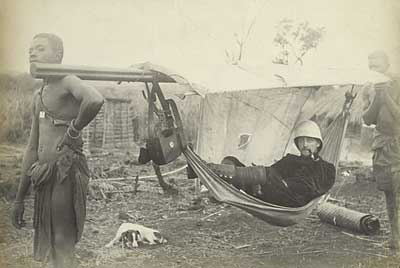
Traveling in a hammock, Belgian Congo
National Museum of African Art
Smithsonian Institution
1977-0001-171
This is my second post on Steven Pinker’s Better Angels of Our Nature (the first is here). This book is such a steaming pile, I need to vent but really don't want to spend time on it.  So I am going to end this particular foray into the colonial mindset and finish up on Chapter 2, which is the main archaeological and anthropological section. In this chapter Pinker argues that there has been a significant decrease in violence as a result of the development of the state. He presents his main evidence for this in a chart—Figure 2-2 in the book, but the same data is presented in two separate charts in an Edge talk he gave. The archaeological charts is below, but it is probably best to look at the chart in the book.


In my earlier post on the topic, I went over some of the more general conceptual issues Pinker faces in comparing non-state/state violence.  In this post I am concentrating on the actual quality of his evidence.  I am just going to talk about the archaeological data, otherwise things are going to get totally unmanageable, and I will never get to stop writing about the book. 

Pinker's evidence that the development of the state led to a significant decrease in violence is gleaned from a grab-bag of archaeological and ethnographic studies--studies that focus on human violence. He uses different datasets at each stage of his chart, none of which I think he really understands. His data for prehistory is the percentage of skeletons showing signs of fatal violence within each site, or group of sites.  The data for modern hunter-gatherer and horticulturalist societies is for the most part ethnographic data gathered through oral histories and reports.  The data for states is probably the most reliable (other than the Ancient Mexico figure). A big problem is here is that, although Pinker intends the chart to compare violent deaths in state and non-state societies, the only actual “state” included in the chart is the US (in 2005). The data are all harvested from secondary sources, some of which are highly questionable, and none of which were trying to answer Pinker’s basic question (actually it is an assumption, but let’s be charitable) —”is there a decline in violence from non-state to state societies?”

Even to those without an archaeological, anthropological, or historical background Pinker’s Figure 2-2 must appear dubious.  The big issue is figuring out exactly what is being compared here; what are the categories on the X axis and what is being measured on the Y axis?  The entities being compared are very different.  We start off with prehistory being represented by cemetery sites, or clusters of cemetery sites, leap to 19th/20th century hunter-gatherer/horticulturalist societies, then we come to “states.”  Notice that of the eight categories here, only one, the “U.S.  2005” is actually a state.  The rest are geographical regions (Ancient Mexico, Europe, and the World).  Pinker has made no effort to maintain an even roughly consistent scale of comparison.  This is important since the bigger the sample, the more variation will wash out.

The time frames represented by each category also fluctuate wildly, from days at one end up to centuries at the other.  What sense does it make to compare a mass-burial from a one-day massacre (the Crow Creek Site) to the planet Earth in the entire 20th century?  What possible conclusion can one draw from such a comparison?  

In the following table, I’ve listed the archaeological sites he uses in his argument.  I reviewed his original sources and, where I could figure it out, included the number of individuals in each cemetery (data that he really should have included).  There are some issues with his data that I need to address before proceeding.  A relatively minor, but still  significant, problem with this figure is how poorly it is cited.  One has to go through a pile of references hoping to find a match.  Fortunately Pinker used only three sources for his archaeological and ethnographic data—Lawrence Keeley’s War Before Civilization: The Myth of the Peaceful Savage (1996), an article in Science by  Samuel Bowles ("Did Warfare Among Ancestral Hunter-Gatherers Affect the Evolution of Human Social Behaviors?"), and Azar Gat’s 20008 War in Human Civilization.  Even so, I couldn't find all the sites in these books, so the chart may not be fully cited.


Site
Dates
# burials
deaths by warfare
Nubia, nr. Site 117
12000-10000 BCE
39
3
Djebel Sahaba Nubia (Site 117)
2000-10000 BCE
41
46
Calumnata, Algeria
6300BCE-5300 BCE
53
4
Gobero, Niger
14000-6200 BCE
35
0
Volos’ke Ukraine
7500 BCE
18
22
Vasiliv’ka Ukraine
9000 BCE
32
1
Boggebakken Denmark
4300-3800 CE
17
12
Vedbaek Denmark
4100 CE
17
14
Skateholm I, Sweden
4100 BCE
30
7
Brittany
6000 BCE
?
8
Ile Teviec France
4600 BCE
16
12
British Columbia 30 sites
3500BCE-1674 CE
745
23
Central California
1500BCE-1500 CE
?
 5
Central California
1400BCE-235 CE
?
5
Central California (2 sites)
240CE-1770 CE (?)
248
4
S. California 28 sites
1400 BCE-235 CE
840
6
Kentucky (2750 BCE)
2750 BCE
?
6
Crow Creek, South Dakota
1325 CE
486
60
Illinois
1300 CE.
264
16
Northeast Plains
1435 CE
?
15
Sara Nahar Rai, India
2140-850 BCE
10
30


I've grouped my carping about the archaeological evidence into three main categories: (1) Pinker's understanding of the data (2) Pinker's sample size, and (3) the manner in which Pinker selected his sample.

1) Poorly understood data

Djebel Sahaba (Site 117) and the “nr. Site 117” Site.  These sites should be grouped.  they probably belong to the same community.  Pinker uses grouped data in other cases, so he probably should here.  Or Djebel Sahaba should be dropped as representing something exceptional, either the remains of a battle or massacre, or the community buried people who died by violence separately.  Speaking the sites that might represent exceptional events…

Crow Creek, South Dakota.  This is a notorious site.  It is a mass grave, the remains of a massacre.  Using this site as just automatically representative of prehistoric mortality is senseless, especially when your sample is already small and biased.  There are no mass graves from Europe in the 20th century?  What would Pinker’s state-level death rates look like if he used cemetery data (as he should have)?

Vedbaek, Denmark, and Boggebakken, Denmark.  This is bad.  Unless there are two Mesolithic sites with 17 burials in Vedbaek, these are the same site.  Keeley calls it Vedbaek; Bowles calls it Boggebakken. The site is sometimes called Vedbaek-Boggebakken (e.g., Jochim 2011:127).  If these are the same site  (as they certainly seem to be), this is probably the most egregious error in Pinker’s data.  The rest of the errors can be attributed to lack of understanding of the evidence and appropriate methods.  But, this, THIS, is sheer laziness. He made no effort to clean his data.

As a side note, this mistake shows the importance of not just dumping other people’s numbers in to a hopper—“Vedbaek” (from Keeley) is 14% mortality, while “Boggebakken” (from Bowles) is 12%-- different numbers for the same site. This is probably because Bowles was only counting adults.  If you are going to use numbers from different studies, make sure the numbers mean the same thing. 

2) Sample sizes

Another issue to be aware of, especially if one quantifying and comparing data, is sample sizes.  Pinker doesn’t include how many individuals are represented by each cemetery in his sample, so I trawled through the sources to recover that information (information that should have damn well been in the book).  The problem here is the smaller the number of individuals in the cemetery, the greater the statistical impact of an individual showing evidence of violent death.  If there are only ten individuals in a cemetery, the percentage will jump by 10% increments.  Those are big jumps.   Note Sara Nahar Rai has a total count of only 10.  Ile Teviec only 16.  Boggebakken has a count of 17 (as does Vedbaek, for obvious reasons :) ).  Volos’ke has 18.  We need to consider whether these are adequate samples, especially when the comparative cases are continents and the entire world.  For Pinker’s analysis, which boils down to visual comparisons of percentages of uncorrected data (with the prehistoric data being summarized as a mean without error bars), I would be hesitant to use anything less than 50, simply because the statistical impact of single deaths is going to be exaggerated. 

3) Sample selection

This is probably the single largest problem with Pinker’s evidence.  In any kind of quantitative study, a first consideration is sample selection.  Is the sample biased?  Is it representative or has the author cherry-picked only the data that supports their position?  What is immediately obvious in reading Pinker’s discussion of his data is the absence of any kind of methodological discussion, and how few sites are presented as evidence.  Those are two big, bright red flags.  Pinker presents his methods for sample selections as being simply the sites “that he knew of”.  The criteria of selection is simply that he knew of the sites, more precisely he knew of these sites because they were given in tables in Keeley (1996) and Bowles (2009)—two sources dealing with violence in prehistory. Keeley was interested in demonstrating the existence of violence in prehistory, not its extent.  For this goal it was adequate to simply find sites where violence existed.  It is basically a collection of anecdotes.  We cannot use his collection of sites to infer the extent of violence because he only picked sites that showed evidence of violence.  The sample is fine for Keeley’s argument, but not for Pinker’s.  Bowles, beyond noting that he “studied all available archaeological and ethnographic sources that present (or are cited as presenting) relevant data”, does not discuss his sample selection at all, which is surprising for a Science article.  The emphasis of his article is on intergroup violence, and his sample is certainly skewed towards cemeteries that show signs of violence.  

If these are the only sites that Pinker “knew of”, he did not do enough research.  What he needed here was some kind of sampling design.  In relying solely on Keeley and Bowles, (as well as Gat for the ethnographic data), Pinker guaranteed, whether he realised it or not, that he would have a dataset consisting of practically nothing but cemeteries that show evidence of violence.  I don’t know how many prehistoric cemeteries have been excavated, and I don’t how many show no evidence of violence (hundreds at least, maybe thousands). Pinker needed a sampling program that would take  into account a population of all known cemeteries, not just those that showed evidence of violent death.  Given Pinker’s selection of the data, it is a given that non-state societies will be more violent, but this is the result of cherry-picked evidence, not necessarily reality.

I think, since WWII, we have seen an overall decline in death by violence.  Does this 60 years translate to “states are less violent than non-state societies.”  Of course not.  I am not sure it is even a meaningful question due to the different ways in which states and non-state societies deliver violence, and due to historical variation.  It may be possible to answer this question, or at least weigh in on it, but Pinker hasn’t done so.  He is not even wrong. You cannot pull something like this off without a great deal of historical understanding. If Pinker has such an understanding, it is not evident in Better Angels.  Instead he approaches the historical disciplines as factoid mines, carefully picking out the numbers he wants, and tossing them into an ideological hopper.  Better Angels fails as science and as history at a very basic level.   

----------------------------------------------------------
References cited

Bowles, Samuel
2009     Did Warfare Among Ancestral Hunter-Gatherers Affect the Evolution of Human Social Behaviors? Science 324(5932):1293–1298.

Gat, Azar
2008     War in Human Civilization. Oxford, UK, Oxford University Press.

Jochim, Michael
2011     The Mesolithic. In European Prehistory: A Survey, Sarunas Milisauskas, editor, pp. 125–152. New York, Springer.

Pinker, Steven
2011a     A History Of Violence Edge Master Class 2011. Edge. http://www.edge.org/conversation/mc2011-history-violence-pinker.

2011b     The Better Angels of Our Nature: Why Violence Has Declined. First edition  New York, NY, Viking

Tuesday, October 2, 2012

Eric Hobsbawm, 1917-2012

Eric Hobsbawm
Wikimedia
Eric Hobsbawm died this week on October 1st, after a long illness.  I was going to say something about his influence on me, but his work is just part of who I am.  He leaves a giant hole in history.


Saturday, September 29, 2012

The state, violence, and Steven Pinker

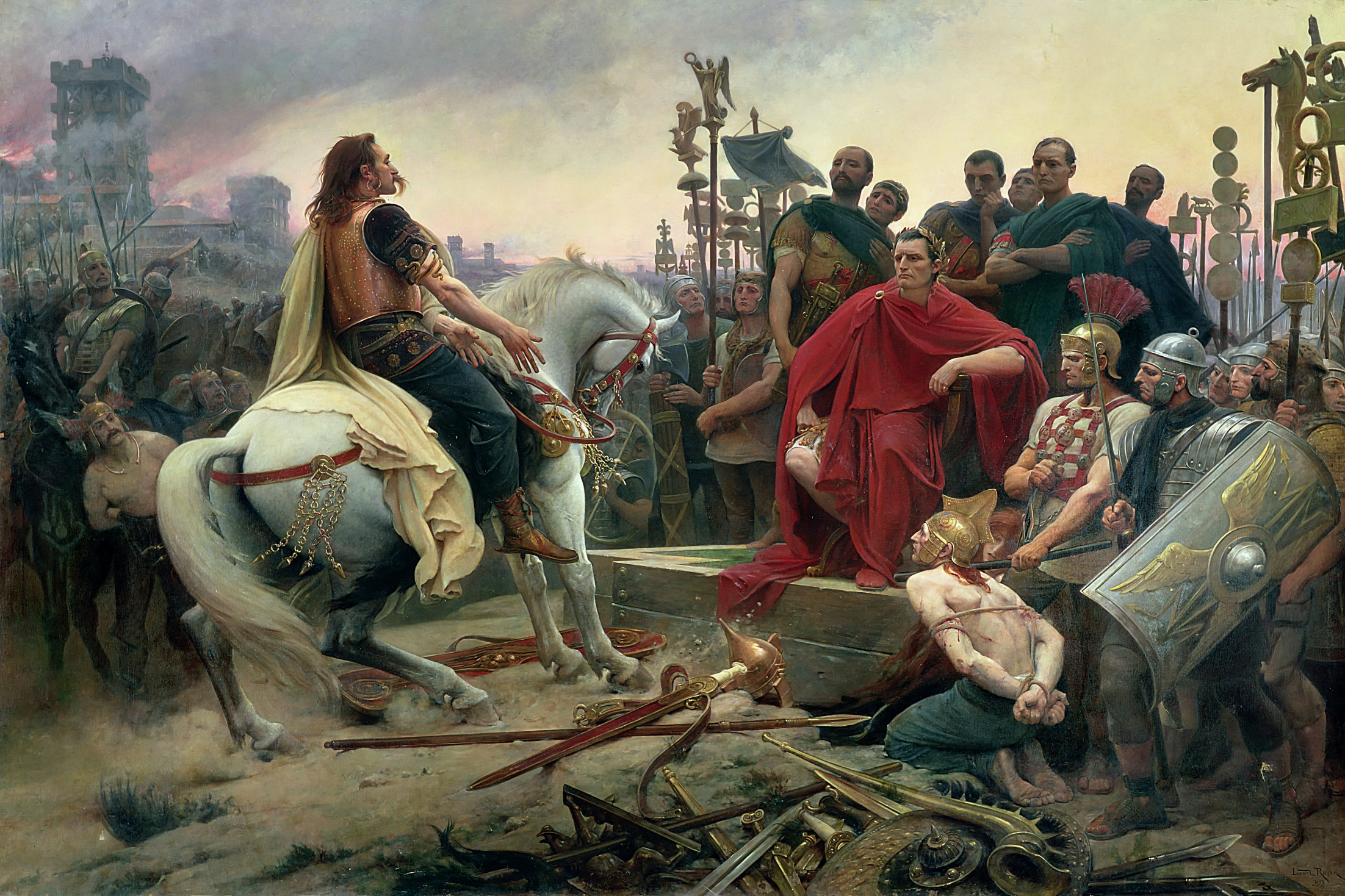
Vercingetorix throws down his arms at the feet of Julius Caesar
Wikimedia commons


Another one on scienceness and history--I recently picked up a copy of Steven Pinker’s latest book, The Better Angels of our Nature: Why Violence Has Declined (Pinker 2011a).  I didn’t finish it.  I made through the first two chapters, flicked through the rest, and reshelved it.  It was enough to convince me that reading the rest of it would not be a productive use of my time.  [Edit: I did finally finish it, but I begrudge every minute I spent on it]. Life is too short for bad beer and this book is Coors Light, and at 835 pages, a 55-gallon drum of Coors Light. I don’t like calling a 800+ page book lazy, especially when I have never written a book, but somehow I feel compelled to do so.  The energy that went into all that writing could have been better directed into research.  A smaller book, but a better book.

To start, Better Angels is Whig history writ large.  There is a progress and a direction to human history, of which the European and North American liberal democracies are the current highest development. Nothing new there, except that Pinker is bringing the cachet of science.

His basic argument is that violence has declined throughout human history.  He has a six-part periodization—the growth of the state, the civilizing process (after Norbert Elias), the Enlightenment, the post –WWII “Long Peace”, the end of the Cold War (post 1989) and the Universal Declaration of Human Right (post 1948).  It’s an odd set of trends, what with everything piling up after WWII.  Pinker’s own lifespan is when historical inevitability really starts kicking into high gear.  “Panglossian” doesn’t begin to describe it.  Possibly there is a brilliant argument making this case later in the book.  I wouldn’t know, I didn’t read that far. 

I couldn’t find where Pinker defines “violence.”  And according to his FAQ, he doesn’t, or rather he just goes with the dictionary definition,  in which ”physical force is exerted for the purpose of causing damage or injury.” As an aside he notes that economic inequality is not violence--“the fact that Bill Gates has a bigger house than I do may be deplorable, but to lump it together with rape and genocide is to confuse moralization with understanding.” While his reduction of economic inequality to Bill Gates having a bigger house than Steven Pinker is jaw-droppingly callow, one can agree that economic inequality is not the same as rape and genocide.  By his criteria, however, a parking lot shoving match is like rape and genocide, while slavery is not.  In this light, his statement about confusing moralization with understanding is disingenuous. 

The key chapter for me was Chapter 2 “The Pacification Process” where Pinker lays out the role of early states in reducing violence--the transition from the “anarchy of the hunting, gathering, and horticultural societies” to the first civilizations. (Chapter 1 is disposable—a series of scene-setting luridly violent vignettes from the standard Western Civ. timeline).  Chapter 2 is key for my purposes because it is where Pinker arrays his archaeological and anthropological evidence.

Nature, culture, and the "Primordialist Fallacy"
He is also making an unusual argument for evolutionary psychology—the transition from non-state societies (which Pinker gratingly refers to as being in “a state of nature”) to state societies is the transition from biology/human nature1 to cultural processes2 as the driving force of history.

So, to give Pinker his due, he does not see culture as just “noise” disguising true human nature.  Better Angels is about the positive role culture (in the form of “civilization”) plays in improving the human quality of life by controlling human nature.  Unfortunately, ability of humans to control their animal natures doesn’t kick in until we have militarized states.  For Pinker, culture is not a factor in non-state societies—they live, after all, in “a state of nature”.

There is a popular idea that if something is older it is more basic to human nature.  I am not sure if the Primordialist Fallacy is an officially-recognised fallacy, but it should be. Once we see culture, learned human behavioural variation, we need to be very cautious about identifying particular behaviours as  primordial rather than cultural. Until we know better, we have no reason to believe humans 3000 years ago were more “natural” than humans 2000 years ago.  It is possible, it is a topic for careful research, but it is not something we can assume.  And primordial human nature is certainly not something we get at, as Pinker does, by drawing a line through state/non-state societies, with human nature on one side and culture on the other.  

Hobbes/Rousseau (like you didn't know that was coming)
A convenient if rather lazy framework for writers on violence and warfare is the contrast between Hobbes and Rousseau.  This contrast provides a tidy narrative and easily defined villains.  Pinker finds the lure irresistible, especially given his propensity for straw-manning potential critics.  So we are treated to a mysterious group of Rousseauian “anthropologists of peace” and even a “peace and harmony mafia” that persecutes dissenters. 

In contrast to Pinker’s Hobbes/Rousseau dichotomy (which, to be fair, he inherited from other authors, particularly Lawrence Keeley and Azar Gat) the mainstream anthropological take is that human violence is a complex and variable phenomenon, and that the prehistoric evidence is spotty and inadequate, no matter what you are arguing.  The evidence is sufficient to say that incidents of violence existed somewhere in the world at certain times.  We will no doubt keep pushing the “earliest  violence” back in time as we discover more.  But does this really tell us something about human nature that we didn’t already know?  Humans have the capacity for violence.  We know that.  But if we want to talk about the scale and intensity of prehistoric violence, or make extravagant claims about its universality, then we need to do some careful research. 

Pinker didn’t do this research, not really. What he did do was trawl a couple of sources (precisely two in the case of the archaeology) for numbers (any numbers) that might support his thesis, no matter how ludicrous they might be.  For example, in later chapters, Pinker’s sources and numbers for the An Lushan revolt (a death rate he claims that amounted to 1/6 of the world’s population) have set off some sniggering on the internet (Quodlibeta: Steven Pinker and the An Lushan Revolt) and even on the staid (and awesome) BBC 4 radio show In Our Time.  It’s not enough to just have a number.  You need to be aware of how that number was generated and why it was generated. 

Where we have good chronological control we can see temporal variations through time and by region (e.g., Lambert 2002). No surprise there.  For example, where we usually have lack of evidence for violence, it is either in the Palaeolithic and Mesolithic, among “simple” hunter-gatherers, or bands. The relative lack of inter-group violence among bands is true ethnographically as well (Fry 2007). The spottiness of evidence for violence in the Paleolithic/Mesolithic is certainly in part due to the nature of the evidence—since we don’t have settlements and fortifications we must rely on skeletal evidence and some rock art.  Even just considering the skeletal evidence, we can see regional and chronological variations.  Some regions, such as Portugal, seem relatively peaceful, while others, such as Scandinavia, appear violent  (Thorpe 2003; 2005).

In Chapter 2, Pinker’s primary evidence is presented in a chart (Figure 2-2) that supposedly shows the decline of human violence from non-state to state societies.  He divides the chart in prehistoric (archaeological) non-state, ethnographic non-state, and (presumably) "state" societies.  The chart is available in Google Books, but a version is also presented in an Edge talk Pinker gave, which is the one I have used here.
Pinker's slide for the History of Violence Edge Master Class, 2011

Pinker arranged the data in this chart to give an impression of declining violence, presumably through time, although we are not sure quite what the X axis represents beyond “Non-comparable things Pinker is comparing”.  There is no particular reason not to arrange them the way he did, but it does serve to wash out variation, to make a complex situation very neat.  I think this probably has something to do with unease evolutionary psychologists have with human variation. They are, after all, in pursuit of a cultureless (i.e., invariant) human nature.

 In the following graphic I have arranged same data roughly chronologically and roughly geographically.  It no longer looks so neat.  Now we see hints of regional variation and sudden wild spikes in violence that might indicate exceptional events, such as wars and battles.  I will be drilling down on this chart in a future post.  There is so much wrong with it that it requires its own post.


Conceptual problems with comparing state/non-state violence
The evidence we have indicates violence varies geographically and temporally.  That makes a simple direct comparison between state and non-state societies a problem.  It seems to be a true observation that states are less violent internally. Elites do have an interest in maintaining a monopoly on violence within the state.  But also states operate on different spatial principles than non-state societies.  In many non-state societies, every group is “on the front line” simply because there is no front-line.  States concentrate violence on their borders, at least if the state is not in crisis. 

1) So if you want to look at the violence of states as measured by death rates, you do not look within the state, you look at the borders and beyond.  We must consider that sometimes a high death rate within a society is not because that society is inherently violent, but because they had neighbours who were inherently violent.  Non-state societies on the borders of states usually experience high rates of violence.  That rate of violence is not because they are a non-state society, but because they border a state society.  They will have a high death rate and the state society will have a low death rate.  States can build up high population densities in areas of low violence.  Non-state societies cannot do this so easily, especially when confronted with a state.

For example, Pinker uses the US in 2005 in the chart because it was one of the countries "worst years for war in decades, with the armed forces embroiled in conflicts in Iraq and Afghanistan.  Together the two wars killed 945 Americans, amounting to 0.0004 (four hundredths of a percent ) of American deaths that year" (Pinker 2011).  As an example of the US' lack of violence, this rather misses the point.  The violence in Iraq in Afghanistan falls primarily on Iraqis and Afghanis--and is caused by the US state. Pinker is looking in the wrong place.

2) Beyond the historical consideration of who is “delivering” the high death rate, there is also the question of comparability.  Violence in non-state societies is “decentralized”, diffuse, and dispersed through out the society.  Everyone has a roughly equal chance of death by violence.  States concentrate violence and are capable of delivering it on a massive scale in a geographically limited area. They “project power” to use the lingo.  In essence the geography of violence in states is unevenly distributed.  The violence of states is not reflected by the death rate within states.    

3) Violence in states is also bureaucratized.  The people who commit the physical act of violence are relatively few but are backed up by often quite massive organizations dedicated to ensuring that that act of violence happens.  For example, after the 3rd century, the Roman state was little than a life support system for the military, a pattern that we often see historically.  What does it mean to say a state, such as Assyria or the late Roman Empire is less violent than a non-state society?  Is the dictionary definition of violence really an adequate metric?

I admire “Big History” and we need more of it.  I, however, don’t do it and I never will.  I work at the academic coalface.  I generate data more than synthesize it, and have to struggle to link archaeological data to broader archaeological and historical issues.  I know my specialty within archaeology, and get uneasy when I am too far from it. So  I don’t have then panache, the devil-may-care disregard for…oh…the niceties of clean comparable data sets that sweeping historical syntheses take.  Nor do I have the time.  But I see the need for big comparative studies, and accept that the data is going to be rough.  Otherwise we just stay mired in the small stuff. But to pull it off you need to do so....much...work.  It is not sufficient to grab other people’s data (i.e. numbers) out of context and shovel them into an ideological hopper without any effort to understand what those numbers represent, and, more to the point, what the potential problems might be.  You need to know what you are doing and you need to know what your data represents.  There is a fine line between devil-may-care and not giving a damn. Pinker doesn’t merely cross that line--he soars over it with an indifference that is almost majestic.
-------------------------------------------------------------------
1The relevant components of human nature are five “demons” (instrumental violence, dominance, revenge, sadism, and ideology (ideology?), and four “better angels”— Empathy, self-control, a moral sense, and reason.

2The cultural/civilizational forces are a bit of a grab bag (1) Leviathan— the state, with its monopoly of force and legal systems, (2) Commerce— which, as we all know, is a “positive sum game” which expands circles of interes, (3) Feminization— an odd one, but it wouldn’t be proper evolutionary psychology without it. It is the growing influence of female nature on violent male culture, (4) Cosmopolitanism—the expanding awareness of other cultures,nations, peoples, etc.  through literacy and mass media, and (5) The escalator of reason— the “intensifying application of knowledge and reason to human affairs”
--------------------------------------------
References Cited

Fry, Douglas P.
2007    Beyond War: The Human Potential for Peace. New York , NY, Oxford University Press, USA.

Gat, Azar
2008    War in Human Civilization. Oxford, UK, Oxford University Press.

Keeley, Lawrence H.
1997    War Before Civilization. Oxford, UK, Oxford University Press.

Lambert, Patricia M.
2002    The Archaeology of War: A North American Perspective. Journal of Archaeological Research 10(3):207–241.

Pinker, Steven
2011a    The Better Angels of Our Nature: Why Violence Has Declined. Viking, New York, NY

2011b    A History Of Violence Edge Master Class 2011 | Conversation | Edge.

Thorpe, I. J.N.
2003    Anthropology, Archaeology, and the Origin of Warfare. World Archaeology 35(1):145–165.

2005    The ancient origins of warfare and violence. In Warfare, violence and slavery in prehistory : proceedings of a Prehistoric Society conference at Sheffield University, Michael Parker Pearson and I. J. N. Thorpe, editors, pp. 1–18. Oxford, UK, Archaeopress.

The Glenwood Erratic petroglyph vandalism: some red flags

The Glenwood Erratic
From The Pincher Creek Voice (C. Davis Photo)

News of unusual vandalism of a petroglyph site (the Glenwood Erratic) in southern Alberta has been making the rounds.  It is not the fact of vandalism that is unusual (unfortunately vandalism of Native American sites is not unusual), but the nature of the vandalism. The vandals reportedly used a power-washer, powerful acid, and a rock drill to destroy the petroglyphs, as well as supporting materiel—a truck, portable generator, and a 16 ft ladder.  That’s not casual vandalism.  It was reported in The Indian Country Today Media Network--“Aboriginal Petroglyphs Destroyed By Vandals Armed With Acid and a Drill.” The Indian Country article is based on a report to the Pincher Creek Voice by one Stan Knowlton, who identified the vandalism ("Local history drilled out and washed away? Update"). This article gives some insight into what might be going on here.  The photos are particularly informative. 

One interesting development is the RCMP, the Alberta Archaeological Survey, the Royal Alberta Museum, and the Writing on Stone archaeological department (the what?! The Writing on Stone Provincial Park  archaeological department) found no evidence that there were petroglyphs at the site or that any vandalism had taken place. 

I can’t reach any solid conclusions about what went on at the Glenwood Erratic, not off a couple of newspaper articles, but there are certainly some red flags in the articles that indicate something odd is going on.
 
Red Flag 1: An unknown form of writing
Knowlton pointed out in his report that this is just the latest in a string of vandalized pictogram and petroglyph sites in Alberta and thinks someone is out to destroy evidence that could prove the Blackfoot First Nations had a written language before European migration.
“I suspect the link to this destruction is to nullify my long held claim that the Blackfoot had a written language before missionaries arrived, which could force archeologists to rewrite history,” Knowlton wrote in his report.
The writings on the erratic—a rock that differs in size and shape from the rock surrounding it, having been transported from its place of origin by glacial action—were highlighted and preserved using red ochre.
“Blackfoot/Cree Blackfoot is the older version of syllabic writing,” he told the Pincher Creek Voice. “This glacial erratic was dropped here about 10,000 years ago. It’s hard to date the writings. It would have been possible to carbon date the oils in the red ochre.” (ICTM)
 The idea the Blackfoot had a written language, a syllabic one to boot, is a big claim.  Full-blown writing systems are usually associated with militarized states, which is unsurprising since writing probably developed out of record keeping and taxation. 

Even more surprising is Knowlton’s claim that he can read this hitherto unknown language
As the lichen crust was so thick it was hard to get a good image of the entire rock surface. Several places were covered in a thick layer of sahm (Red Ocher) and the syllabic characters were partially exposed. The best I could make out was NA WE NI T_ __ __ __ O ^. The whole surface was a face and the syllabic characters were in or near the eyes. [Knowlton 2012]
Since whatever Knowlton claimed he saw is no longer there, and since he made no record of it when he did see it, not so much as a cellphone photo, we can't say much.  Previous claims of precontact writing systems in North America have not panned out.  Probably the most notorious one is Barry Fell and his identification of something called “Punic Ogham” all over North America, pretty much anywhere he found parallel scratches.

Knowlton’s claim that red ochre survived for hundreds, possibly thousands, of years on a very exposed erratic on the prairie also needs to be examined carefully.  It seems unlikely. 

Red Flag 2: The Evidence
Obviously there is no evidence for writing (since it has been destroyed) but the evidence for the vandalism itself, at least as given in the photos, is not convincing.  The staining and discolored depression supposedly caused by acid is visually indistinguishable from natural weathering and water staining.
Acid/detergent damage
From The Pincher Creek Voice (C. Davis Photo)
The drilled section looks bad until you realise it is only an 8x4 inch area.  They are not drill holes, but core holes.  They were made by a hollow drill.  This looks like geological sampling, which is what the RCMP investigation concluded. 
Drill damage
From The Pincher Creek Voice (C. Davis Photo)
There is apparently a second drilled area, but since this is the one that is appearing in the media, it is safe to assume it is the more dramatic example.

The amount of work Knowlton is claiming the vandals put in is also eye-raising.  Who hauls out a generator, lights, a drill, 100+ litres of detergent, and powerful acid to destroy petroglyphs?  What the hell is wrong with using a hammer?

Red Flag 3: Conspiracy theory
I am not sure what evidence Knowlton has for his writing theory, but one thing we do know is that what evidence exists is being destroyed by a cabal of archaeologists (of course).
 After spending an hour or two at the Glenwood Erratic site, Stan Knowlton took us on a lengthy tour of another site on the Piikani Nation. Following a path that he said was the original pioneer highway for wagons running between Fort Macleod and Pincher Creek, we came to an area that demonstrated the systematic destruction of a culture.  Huge holes left behind are now all that are left of the erratics there and pillars that were deliberately dynamited in the 1920's in an apparent attempt to remove any and all references to the culture that existed there before the europeans came.  Historian George Classen wrote "Stonehenge of the Foothills" about this site. [Davis and Lucas 2012]
 And in Knowlton's own words:
In 1884, George Dawson records petroglyphs located on the bank of the big bend in the river west of Monarch, they are gone now. In the 1960's the Big Rock at Okotoks had petroglyphs and those were drilled out and recently sanitized. Now, Glenwood. George Classen stated in 1993 that these type of arky site were "slated for destruction." We must now find whom and why these Archaeology sites are being targeted or nothing in Alberta is safe. [Knowlton 2012]
And
Today, September 13, 2012 I found a well-dressed Man from Edmonton washing down Big Rock graffiti.  This man claimed to belongs to a group of four under a supervisor that also does graffiti cleaning as well.  They have their own pressure washer but must get approval from the Head Archaeologist before they can use acid or special detergents.  This interesting gentleman claimed they have a data base of over eight hundred sites across Alberta, including Glenwood. The crew is said to have been visiting sites in Southern Alberta over the last few days.
There are pictographs at Big Rock as well as petroglyphs.  A lot of the pictographs have been destroyed by harsh chemicals and the pictographs have been covered over with epoxy cement.[Knowlton 2012]
And
"I suspect the 'link' to this destruction is to nullify my long held claim that the Blackfoot HAD a written language before missionaries arrived, which could force archaeologists to rewrite history". [Knowlton 2012]
Knowlton also does not explain how the representatives of the International Archaeological Conspiracy ™ (IAC) found out about the his petroglyphs when he was the one who found them. I suppose he may have reported them, but if he didn’t have photos I doubt anyone at the IAC would have been worried about having their theories overturned.

And let's get real,if these guys are well-dressed as Knowlton claims, then they are probably not archaeologists.  QED. 

When people start using conspiracy theories to explain their lack of evidence you don’t need to listen to anymore. This is true in any field. The bigger and more elaborate the conspiracy, the less likely it is, especially if the conspirators are archaeologists—nobody wants a conspiracy of garrulous boozers.   

Supposed unknown writing systems, maps engraved in rock, monumental architecture, and the like, that are actually natural features are pretty common.  The proponent usually has something he is pointing to, even if it is natural.  The unusual thing about this case is the claim that the evidence had been destroyed, when, apparently, it hadn’t—it was just never there.  I am not sure what is going on there. 

In the end the problem here is not with the archaeologists, it is with Knowlton.  By his account he knew those petroglyphs were there, and he didn’t record them when he was there, not a cellphone photo, not a drawing.  That’s not responsible, especially since he thinks there is a concerted conspiracy to destroy such petroglyphs.  Instead we get a unsupported story of them being destroyed the night before he was going to go out there and record them. 

Vandalism of Native American heritage is common enough that the police are often surprised to find out that there are often laws against...if they bother to check at all.  My first reaction when the articles about the Glenwood Erratic starting showing up in my feeds was that the vandalism happened and that the vandals were unusually determined.  I wondered if there was some personal animosity involved. I didn't pay much attention to the red flags until I heard the RCMP and the relevant archaeologists hadn't found any vandalism.  When I went back and looked again, the problems with the claims (as presented) were obvious.  There's a lesson there.

It's also a shame that it is a dubious case like this that is getting such coverage. But then, what makes it dubious is probably what is getting it the coverage. 

 ---------------------------------
References cited

Davis, Chris, and Toni Lucas
2012  "Local history drilled out and washed away." Pincher Creek Voice, September 17, 2012

ICTM (Indian Country Today Media Network)
2012 "Aboriginal Petroglyphs Destroyed By Vandals Armed With Acid and a Drill" The Indian Country Today Media Network, September 18, 2012.

Knowlton, Stan
2012  "Desecration of the Glenwood Erratic." Pincher Creek Voice, September 17, 2012